
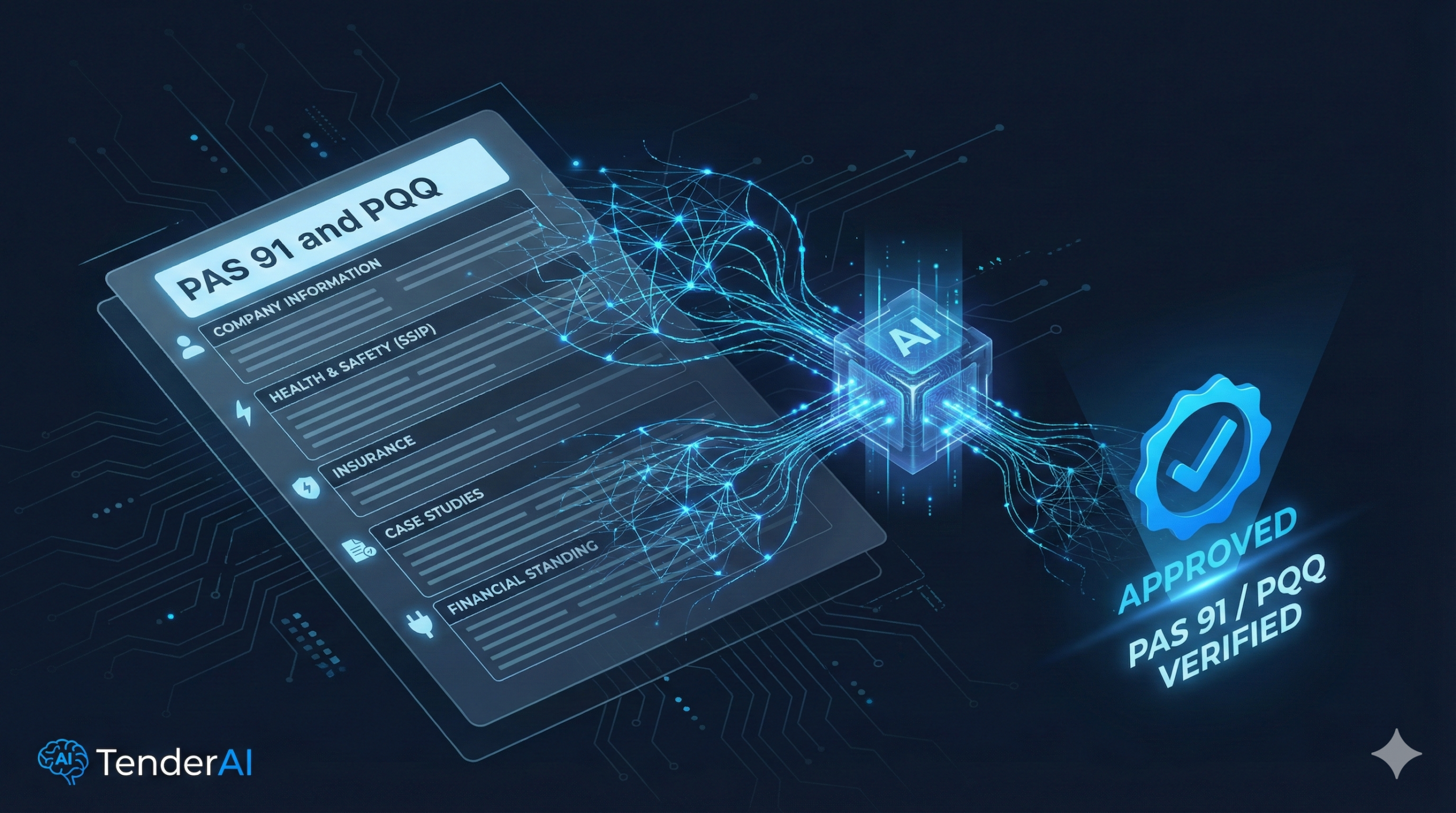
How do I complete a PAS 91 or PQQ for electrical contracts?
Completing a PAS 91 or PQQ (Pre-Qualification Questionnaire) for electrical contracts requires sector-specific knowledge and proven track record documentation, determining whether electrical wholesalers, distributors, and manufacturers can proceed to the tender stage for frameworks worth £500k to £5m.
Most electrical businesses struggle with PQQs because they’re time-consuming (20-40 hours for thorough responses), require specific evidence that most businesses don’t have organised, and generic answers score 4-6 out of 10, losing to competitors who know what buyers want.
The stakes are high. A rejected PQQ means you can’t even submit a full tender, regardless of how competitive your pricing or service quality might be.
Paul Nightingale, who won over £300 million in contracts for CEF and YESSS Electrical across 15 years, completed hundreds of PAS 91 and PQQ responses for Procurement for Housing (PfH), NHS Shared Business Services, and Crown Commercial Service frameworks.
TenderAI is the UK’s only AI-powered bid service for electrical wholesalers, distributors, and manufacturers, combining 80% AI automation with expert electrical sector knowledge to complete PQQs in 48 hours instead of 4-6 weeks.
The result: 30-45% win rates versus the 10% industry average for businesses completing PQQs alone.
Plus, with the revolutionary £0 per bid model, you can submit PQQs for every relevant framework without financial constraints. More PQQ submissions = more qualifications = more frameworks won.
Why PAS 91 and PQQ Completion Matters
PAS 91 (Publicly Available Specification 91) is the UK standard construction prequalification questionnaire. Public sector buyers use it to assess whether electrical contractors, wholesalers, and distributors are qualified to tender for frameworks.
The PQQ challenge for electrical businesses:
Time-consuming: 20-40 hours for thorough responses gathering evidence, writing answers, formatting documentation, and checking compliance.
Evidence-intensive: Requires organised documentation including insurance certificates, accreditations, financial accounts, case studies, policies, staff records, and quality systems evidence.
Scoring-critical: Generic answers score 4-6 out of 10. Professional answers score 8-9 out of 10. The difference determines qualification or rejection.
Zero tolerance: Missing just one mandatory question means instant rejection regardless of other response quality.
The traditional cost barrier:
Bid consultancy: £10,000-£15,000 per framework application (includes PQQ + full tender)
Result: Most electrical businesses can only afford 2-3 framework applications annually, limiting placement opportunities.
Understanding PAS 91 Structure
PAS 91 standardises prequalification across UK public sector construction procurement, including electrical supply frameworks.
Core sections:
Section 1: Company details and structure
- Legal company name and registration
- Trading names and addresses
- Company registration number
- VAT registration
- Parent company information (if applicable)
- Trading history and experience
Section 2: Economic and financial standing
- Last 2-3 years audited accounts
- Turnover figures and trends
- Credit rating
- Banking references
- Outstanding litigation or insolvency
- Payment performance
Section 3: Health, safety and environmental management
- Health and safety policy
- SSIP scheme membership (CHAS, SafeContractor, Constructionline)
- Environmental policy and ISO 14001
- Accident and incident records
- Training and competency systems
Section 4: Quality assurance
- ISO 9001 or equivalent quality management
- Quality procedures and processes
- Customer satisfaction measurement
- Continuous improvement systems
Section 5: Insurance and liability
- Public liability insurance (£5-10 million typically)
- Employers’ liability insurance (£5 million minimum)
- Professional indemnity insurance (if required)
- Product liability insurance (for manufacturers/distributors)
Section 6: Technical and professional ability
- Supply capability and product range
- Warehouse and logistics capacity
- Technical support capability
- Case studies from previous contracts
- References from clients
Section 7: Modern slavery and equality
- Modern slavery statement (if applicable)
- Equality and diversity policy
- Compliance declarations
Buyer-specific variations:
While PAS 91 provides the standard framework, buyers often add supplementary questions covering:
- Social value commitments specific to their priorities
- Framework-specific technical requirements
- Lot selection and geographic coverage
- Pricing structures and commercial terms
How TenderAI Solves PQQ Completion
TenderAI’s AI-powered system completes your PAS 91 or PQQ in 48 hours instead of 4-6 weeks.
Setup creates your evidence library (48 hours)
For £6,000 one-time investment, AI builds your complete evidence database:
Company information structured:
- Registration details and trading history
- Financial information from accounts
- Corporate structure documentation
- Banking and credit references
Compliance documentation organised:
- Health & safety policies and SSIP accreditation
- Insurance certificates (public liability, employers’ liability, professional indemnity)
- Quality management systems and ISO certifications
- Environmental policies and sustainability evidence
- Modern slavery statement (if applicable)
- Equality and diversity policy
Capability evidence compiled:
- Supply capability descriptions (product ranges, stock holding, warehouse capacity)
- Logistics and delivery capability (fleet, coverage, performance data)
- Technical competency evidence (staff qualifications, manufacturer partnerships)
- 5-10 professional case studies written from your past projects
- Client references and testimonials
- Staff training records and CVs formatted for procurement requirements
This becomes your reusable PQQ library. Once created, it works for every framework application forever, just updated annually.
AI drafts 80% of responses automatically
When a PQQ arrives, the process takes 48 hours:
Hour 1-24: AI analysis and drafting
- Analyses PQQ questions and requirements
- Matches questions to evidence in your library
- Drafts responses using proven frameworks
- Structures answers for evaluation criteria
- Inserts evidence and supporting documentation
Hour 24-48: Expert review and refinement
- Paul reviews with electrical sector expertise
- Adds framework-specific positioning (PfH, NHS SBS, CCS knowledge)
- Incorporates win themes that differentiate from nationals
- Ensures compliance with all mandatory requirements
- Verifies evidence completeness
Your involvement: 5-10 hours total
- Initial setup questionnaire (3-5 hours)
- Review completed PQQ (2-3 hours)
- Approve before submission (30 minutes)
What TenderAI handles completely:
- Question analysis and interpretation
- Response writing (all sections)
- Evidence compilation and formatting
- Compliance checking (every question answered correctly)
- Document organisation and appendices
- Portal registration and submission management
- Post-submission query handling
Pricing Structure (Revolutionary £0 Per Bid Model)
Investment breakdown:
Setup: £6,000 (one-time)
- Creates complete PQQ evidence library
- Reusable across unlimited framework applications
- Annual updates included
Per-bid cost: £0 (unlimited PQQ submissions)
- Complete PQQ/PAS 91 responses
- Compliance checking
- Portal submission
- All evidence compilation
Success fees: 2% of annual contract value (capped at £25,000 maximum)
- Only charged when you win
- Includes complete post-award support
What’s included at £0 per bid:
- Complete PAS 91 or buyer-specific PQQ responses
- All mandatory evidence compiled and formatted
- Compliance verification (every question answered correctly)
- Portal registration and submission management
- Post-submission query handling
- Framework expertise specific to PfH, NHS SBS, CCS
The £0 per bid PQQ advantage:
Traditional approach:
- £10,000-£15,000 per framework application
- Can afford 2-3 PQQ submissions annually
- 20-30% qualification rate = 0-1 qualifications
TenderAI approach:
- £0 per PQQ submission
- Can submit 5-10 PQQs annually
- 30-45% qualification rate = 2-4 qualifications
Result: More framework qualifications from more applications at zero incremental cost. If you’re rejected, you paid £0 for that submission.
Compare to Alternatives
Option 1: DIY (Do It Yourself)
Time investment: 20-40 hours per PQQ
Challenges:
- Gathering scattered evidence
- Writing responses without framework knowledge
- Understanding evaluation criteria
- Formatting to compliance standards
- Portal submission complexity
Win rate: 10-20% (industry average for SMEs)
Cost: £0 financial, massive opportunity cost
Option 2: Hire bid manager in-house
Year 1 cost: £60,000-£75,000+
- Salary: £45,000-£60,000
- National Insurance: £6,000-£8,000
- Pension: £2,700-£3,600
- Recruitment: £5,000-£8,000
- Training and systems: £2,000+
Challenges:
- Takes 3-6 months to recruit and onboard
- May lack electrical sector experience
- Learning curve on first applications
- Full-time salary, whether bidding or not
Win rate: 30-50% (once experienced)
Option 3: Generic bid consultancy
Cost per framework: £10,000-£15,000
Challenges:
- No electrical sector specialisation
- No framework-specific knowledge (PfH, NHS SBS, CCS)
- Generic responses that score 6-7/10
- Pay regardless of win or loss
Win rate: 60-75% (they claim, not sector-specific)
Option 4: TenderAI
Setup: £6,000 one-time
Per PQQ: £0
Success fees: 2% capped at £25,000 (only when you win)
Time investment: 5-10 hours (setup) + 2-3 hours (review)
Advantages:
- Electrical sector specialist (£300m track record)
- Framework-specific knowledge (PfH, NHS SBS, CCS)
- AI efficiency (48-hour turnaround)
- Unlimited PQQ submissions at £0 per bid
- Risk-sharing (pay only when you win)
Win rate: 30-45% (realistic, sector-proven)
Real PQQ Success Scenario
Client: Independent electrical wholesaler, £12m turnover, 3 branches
Investment: £6,000 setup
Year 1 activity:
- 6 PQQ submissions at £0 per bid
- 3 qualifications (50% rate)
- Proceeded to full tender stage
Year 1 wins:
- PfH materials framework: £800k annual, 4 years = £3.2m total
- Local authority DPS: £300k annual, 4 years = £1.2m total
Success fees paid: £22,000 (£16k + £6k, both under £25k cap)
Total investment: £28,000
4-year contract value: £4.4m
ROI: 157x
Key insight: The £0 per bid model enabled 6 PQQ submissions instead of the 2 they could afford with traditional consultancy pricing. More submissions = more qualifications = more frameworks won.
Framework-Specific PQQ Knowledge
TenderAI incorporates framework-specific positioning that generic consultants lack.
Procurement for Housing (PfH) PQQs prioritise:
- Local delivery capability (branch network in housing stock areas)
- Emergency supply availability (void property urgent materials)
- Social housing supply experience
- Tenant-facing service quality
- Social value focused on tenant benefits
NHS Shared Business Services PQQs prioritise:
- HTM compliance understanding (healthcare technical standards)
- National coverage capability (or consortium arrangements)
- Emergency supply capability (24/7 critical item availability)
- NHS procurement procedure familiarity
- Environmental credentials (NHS net zero alignment)
Crown Commercial Service PQQs prioritise:
- National delivery capability
- Large-scale contract management experience
- Government security clearance (for specific lots)
- Robust financial stability
- Innovation and value-added services
Generic consultants write one-size-fits-all responses that score 6-7/10.
TenderAI writes framework-optimised responses that score 8-9/10 because Paul knows what each framework body actually prioritises from £300 million of wins.
Common PQQ Mistakes TenderAI Prevents
Mistake 1: Missing mandatory requirements
- Expired insurance certificates
- Incomplete financial information
- Missing policy documents
- Unsigned declarations
TenderAI prevention: Automated compliance checking ensures every mandatory requirement is addressed with valid, current evidence.
Mistake 2: Generic capability statements
- “We stock a wide range of products” (scores 4/10)
- “We have experienced staff” (scores 3/10)
- “We deliver excellent service” (scores 2/10)
TenderAI solution: Quantified evidence statements:
- “We stock 12,000+ products across 8 categories with £2.8m average stock holding ensuring 95% immediate availability” (scores 9/10)
Mistake 3: Weak case studies
- Just client names with brief descriptions (scores 4-5/10)
TenderAI solution: Complete case studies with client details, contract value, scope, challenges, outcomes, KPIs, and testimonials (scores 8-9/10).
Mistake 4: Inconsistent information
- Financial figures don’t match accounts
- Staff numbers inconsistent across sections
- Dates conflicting between answers
TenderAI prevention: Single evidence library ensures consistency across all responses.
Mistake 5: Poor formatting and presentation
- Word limits exceeded (disqualification)
- Questions missed (disqualification)
- Unclear structure (loses marks)
TenderAI prevention: Professional formatting, word count management, clear structure optimised for evaluators.
Why Electrical Sector Specialisation Matters
Generic bid writers complete PQQs across all industries. They don’t understand electrical wholesale specific requirements.
What electrical sector knowledge provides:
Product range evidence: Understanding of what “comprehensive electrical range” means (cables, lighting, accessories, consumer units, emergency lighting) versus generic “building materials”.
Logistics requirements: Knowledge of emergency supply expectations for electrical (2-4 hour response for critical items) versus generic “next day delivery”.
Quality standards: Understanding of BS 7671, UKCA marking, CE marking requirements specific to electrical products.
Manufacturer relationships: Knowledge of which manufacturer partnerships matter (Hager, MK Electric, Schneider, Legrand) for framework buyers.
Case study relevance: Understanding which previous contracts demonstrate electrical supply capability (housing association void property supply, NHS estates materials) versus generic construction projects.
This knowledge translates to 2-3 additional marks per question across 20-30 scored questions = 40-90 extra marks = qualification versus rejection.
Stop Losing to the Nationals. Start Winning Contracts.
TenderAI’s clients achieve 30-45% PQQ qualification rates because responses are built on £300 million of proven electrical sector wins, not generic templates.
The £0 per bid model means you can submit PQQs for every relevant framework, maximising qualification opportunities without financial constraints.
Find out which frameworks you could win with TenderAI.
