
How do I respond to a short-notice tender opportunity?
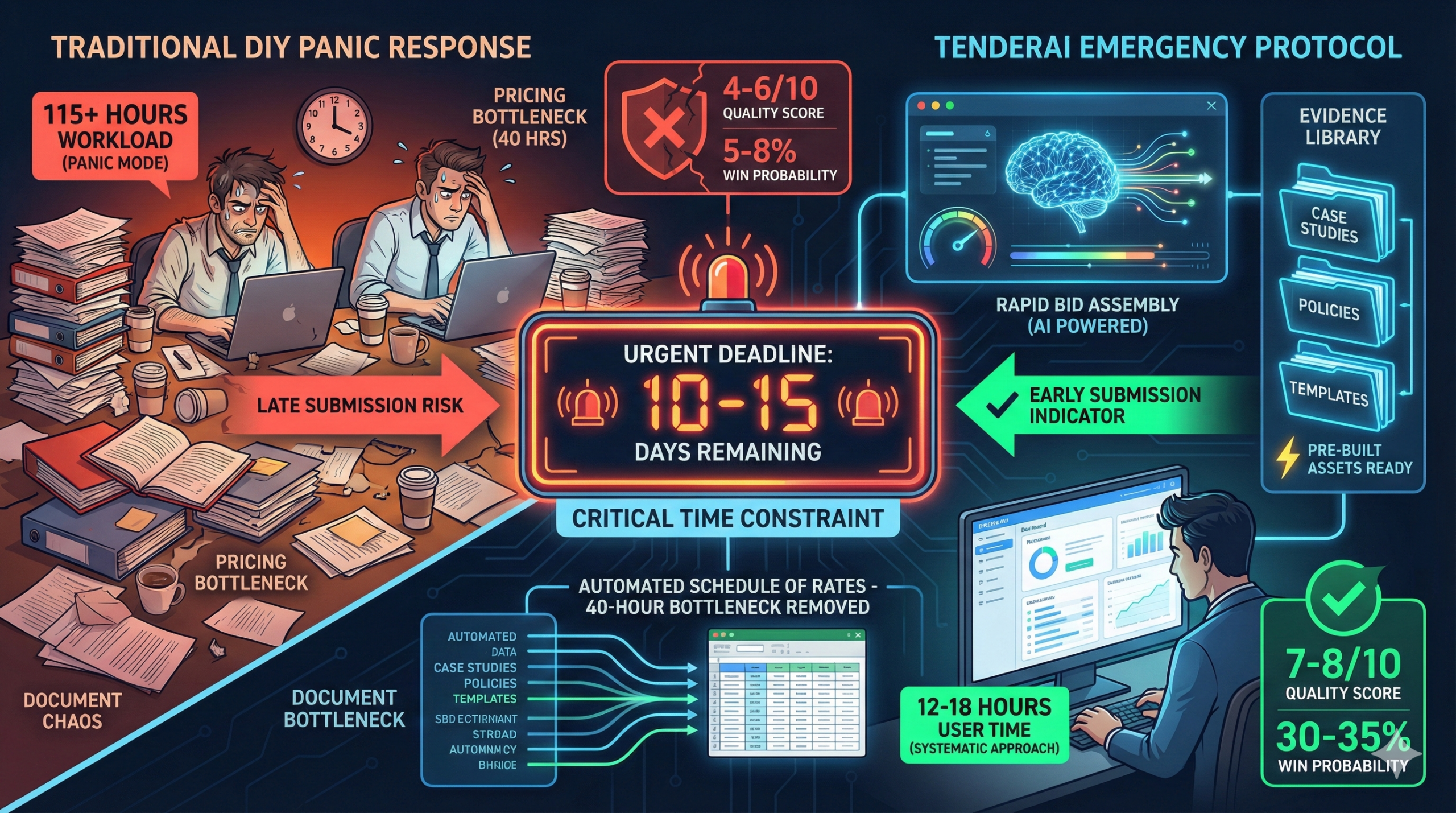
Responding to short-notice tender opportunities requires a pre-built evidence library that allows rapid bid assembly in 10-15 days instead of the typical 4-6 weeks most businesses need.
Paul Nightingale developed emergency response protocols during his 15 years at CEF and YESSS Electrical, enabling responses to opportunities discovered with only 2-3 weeks until deadline whilst maintaining quality that scored 8-9 out of 10.
TenderAI is the UK’s only AI-powered bid service for electrical wholesalers, distributors, and manufacturers. AI automation compresses bid preparation from 100+ hours to 48-72 hours, achieving 30-35% win rates on short-notice opportunities versus 5-8% for businesses rushing last-minute submissions.
Why short-notice opportunities happen
Most electrical businesses discover tenders late because monitoring isn’t systematic.
Portal checks happen weekly instead of daily. Framework launch emails get buried in spam. Contractors mention opportunities at industry events when deadlines are already close.
The result: attempting 4-6 weeks of work in 10-15 days.
Most businesses either don’t bid or submit rushed responses that score 4-6 out of 10.
What 10-15 days looks like DIY
Days 1-2: Download tender, decide go/no-go, assign responsibilities (10-15 hours).
Days 3-7: Rushed quality responses, case studies written from scratch, generic method statements (60-80 hours compressed).
Days 8-12: Chaotic Schedule of Rates pricing with incomplete analysis (30-40 hours).
Days 13-14: Minimal review, last-minute portal submission panic (15-20 hours).
Total: 115-155 hours spread across evenings and weekends.
Quality outcome: 4-6 out of 10 scores due to generic answers, compliance errors, pricing mistakes, and poor structure.
Win probability: 5-8% for rushed submissions.
The TenderAI emergency protocol
TenderAI responds to opportunities discovered with 10-15 days remaining because your evidence library already exists from the £6,000 setup.
Days 1-2: You contact TenderAI. Paul reviews requirements and recommends go/no-go. 30-minute decision call. Cost to bid: £0.
Days 3-5: AI analyses requirements and drafts 80% of responses using your existing evidence library. AI prices Schedule of Rates using manufacturer database. Paul refines with electrical sector expertise. Your time: 3-5 hours providing clarifications.
Days 6-9: You receive fully priced Schedule of Rates at cost. Review margins and approve. Your time: 5-8 hours.
Days 10-12: Review complete bid, approve, TenderAI submits 2-3 days before deadline. Your time: 2-3 hours.
Total: 12-18 hours your time across 10-12 days.
Quality outcome: 7-8 out of 10 (competitive despite compressed timeline).
Win probability: 30-35%.
What makes emergency response possible
Your evidence library already exists:
The £6,000 setup creates 5-10 professional case studies, policies, templates, and documentation ready for rapid assembly.
Emergency bids succeed because AI selects relevant evidence in hours, not weeks.
AI eliminates 80-90 hours:
Manual writing takes 60-80 hours. AI drafts 80% in 8-12 hours whilst you focus on other priorities.
Schedule of Rates pricing automated:
Manual pricing takes 30-40 hours. AI matches line items to manufacturer products in 4-6 hours. You review margins in 2-3 hours instead of 40.
No emergency premium:
Setup fee: £6,000 (completed before emergency).
Per-bid cost: £0 (same as non-emergency).
Win fee: 2% of annual contract value (capped £25,000), only when you win.
Traditional consultancies charge 150-200% premium for rushed work (£15,000-£22,500).
TenderAI charges £0 until you win because AI automation doesn’t require additional resource for emergency response.
Stop losing to the nationals. Start winning contracts.
Find out which frameworks you could win with TenderAI.
